

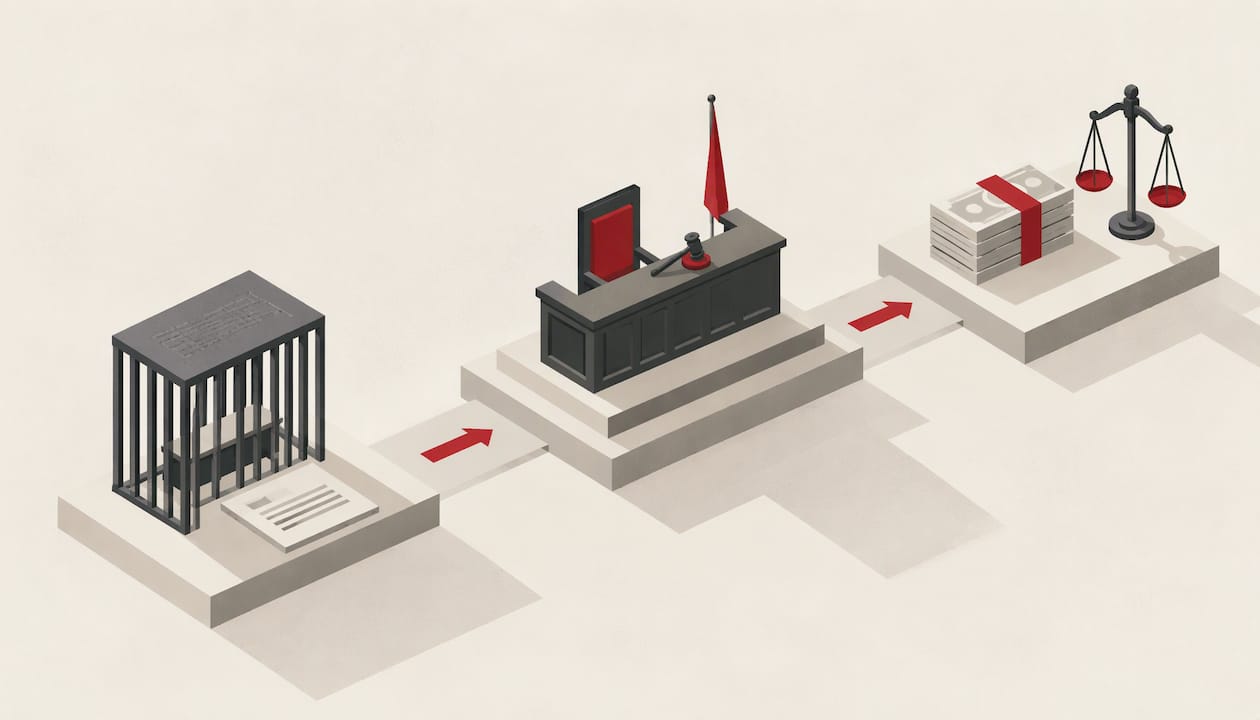
Bail is set by a judge or magistrate, or, in the first hours after an arrest, by a preset bail schedule that attaches a dollar figure to the charge. The amount reflects how serious the charge is, the person’s record and history of showing up to court, and their ties to the community. If you are trying to get someone out of the Clark County Detention Center, the useful question is which of those two routes applies to your case right now, because that decides how fast release can happen and what it will cost. At Fast Bail Bonds in Las Vegas, we walk families and co-signers through exactly that: what the number is, what it means for you, and what you are agreeing to if you sign.
TL;DR
- Bail is set either by a schedule (a fixed amount for a specific charge) or by a judge at a hearing, who can raise it, lower it or release the person without money.
- Judges weigh the seriousness of the charge, criminal record, past court appearances, flight risk, danger to others and local ties such as family and work.
- The bail amount is the sum the court requires. A bail bond is one way to cover it, and the co-signer takes on real financial responsibility.
- Posted bail is generally returned when the case ends and the defendant has attended every hearing. Missing court can mean forfeiture.
- If the amount feels out of reach, a hearing to ask for a review is the normal next step, and a bondsman can explain your options before you sign anything.
Table of Contents
- Who sets bail
- What a bail schedule does, and what it does not
- What determines the bail amount
- Bail amount explained: what the number means
- What a co-signer is taking on
- If the amount is too high: asking for a review
- How we help once the amount is set
- What to do in the first hours
- FAQ
- Sources
Who sets bail
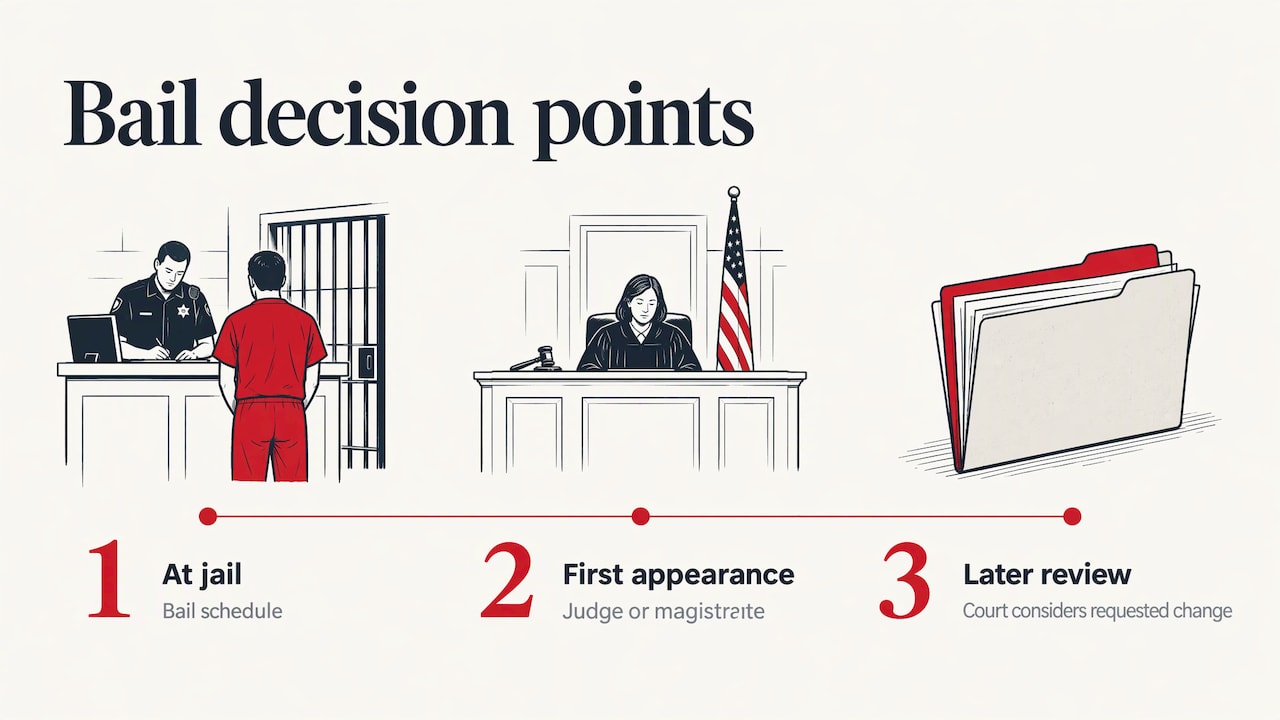
There are three points in a case where a bail number can be fixed, and different people set it at each one.
At the jail, by schedule. Courts keep a bail schedule: a list that pairs common offenses with set amounts. It exists so that someone arrested for a routine charge can post bail within hours, without waiting for a judge. In Clark County, a defendant whose charge appears on the schedule and who can pay the listed amount, directly or through a bond, can usually be released without a hearing.
At the first court appearance, by a judge or magistrate. A magistrate is a judicial officer whose job at this stage is to decide release conditions, not guilt. Massachusetts’ official guide describes the bail magistrate as a public officer whose only job is to set bail, and the same idea applies across the country. Nevada law presumes release: under NRS 178.484, a person arrested for any offense other than first-degree murder must be admitted to bail, with the statute setting specific rules for some categories, including certain domestic violence arrests.
Later, when someone asks for a change. A defendant, usually through a defense attorney, can ask the court to reduce bail or change conditions if circumstances shift or the first number was set quickly.
A few states add their own twist. In Connecticut, for example, police set bail at arrest and Pretrial Services staff can raise or lower it after an interview. The structure differs by state, so the local rules are the ones that count. Here, that means Nevada and the Clark County courts.
What a bail schedule does, and what it does not
A schedule is a starting point. It treats the charge as the main fact, which is why two very different people arrested for the same offense can face the same number.
Some courts are required to look past it. Georgia’s judicial bench card for misdemeanor bail says using a bail schedule as the only way to assess bail is improper. Texas guidance for magistrates says a schedule must make the magistrate consider all the statutory factors, including the ability to make bail, the nature of the offense and criminal history.
What this means for you in practice: the schedule number you hear at the jail is often not the final word. If the person cannot be released on that number, a judge will typically review the case at an initial appearance. Local practitioners describe this review as happening within 48 hours of arrest in Clark County. Ask the jail or the court clerk when the hearing is, because the hearing date is the next realistic chance to see the amount change.
What determines the bail amount
Judges are not guessing. They work through a list of questions that all point at two risks: that the person will not come back to court, and that the person will harm someone or interfere with the case.
Massachusetts’ guide lists the factors in plain terms: the type of crime and potential penalty, criminal record, any history of defaults, flight risk, harm to the community or a victim, probation or parole status, local ties and employment. Connecticut’s statute-based criteria are similar: the nature of the offense, previous convictions, past court appearances, family ties, employment, financial resources, character and community ties.
Put together, the factors fall into five groups:
| Factor | What the court is asking | What tends to push the amount up | What tends to bring it down |
|---|---|---|---|
| Seriousness of the charge | How severe is the penalty if convicted? | Felony, violence, weapons | Low-level misdemeanor |
| Criminal record | Has this person been convicted before? | Prior convictions, offenses committed while on release | No record |
| Court history | Do they show up when told to? | Prior missed court dates | A clean attendance record |
| Risk to others | Is anyone in danger? | Alleged harm to a victim or witness | No alleged victim, no threats |
| Ties to the area | Will they stay and return? | Little local connection | Steady job, family, a home nearby |
Two more things matter in the real world.
Release conditions can replace money. Under the federal system, the Congressional Research Service notes that a judge may release a defendant on personal recognizance or an unsecured bond, or on the least restrictive set of statutory conditions such as travel limits, curfew or reporting. In California, a 2021 decision means a court must consider nonfinancial conditions and the defendant’s ability to pay before setting a bail figure that keeps someone jailed only because they are poor. Ohio’s law, effective in 2023, tells courts to release on the least restrictive conditions that reasonably assure appearance and safety.
Some charges carry extra rules. Nevada’s statute sets particular bail floors and conditions for certain domestic violence arrests, depending on prior convictions and whether harm or strangulation is alleged. If the charge is domestic violence, do not assume the amount works like an ordinary schedule number. We can explain how our domestic violence bail bonds work for your specific situation.
Bail amount explained: what the number means
The bail amount is the sum the court requires as a guarantee that the defendant returns. It is not a fine and not a penalty. When the case ends and every court date has been kept, the money is generally returned. Massachusetts’ guide, for instance, says the court holds cash bail until the case is over, and Connecticut returns posted money on acquittal, dismissal or sentencing.
There are two main ways to cover the amount:
- Cash bail. The full amount is paid to the court. Anyone can do this, and the money comes back at the end of the case if the rules were followed. In Las Vegas, posting happens at the Regional Justice Center across from the detention center during business hours.
- A surety bail bond. A bail bond company guarantees the full amount to the court, and the family pays the company a premium, a fee for that service. The premium is the cost of the bond, and it is how the family avoids tying up the entire bail amount in cash. Our page on cash bail versus a bail bond premium in Nevada shows the difference side by side, and our guide to bail versus bond clears up the terms that families often mix up.
A worked example makes the difference concrete. Say the schedule or the judge sets bail at $10,000. With cash bail, someone hands the court $10,000 and gets it back when the case is over. With a bond, a premium is paid to the bond company, and the court is satisfied without the full $10,000 changing hands. The premium is the cost of that convenience and is not refunded. The percentage and any collateral terms depend on the agreement, so we go over your exact numbers before anything is signed.
What a co-signer is taking on
If you sign for a bond, you are the person the bond company looks to if things go wrong. In plain terms:
- You are promising the defendant will attend every court date.
- You are responsible for the premium and any agreed payment or collateral terms.
- If the defendant misses court, the court can order the bail forfeited, and you can be asked to answer for it.
Forfeiture is not unique to Nevada. Massachusetts says that if a defendant misses a court date, the judge may order the bail forfeited, meaning the money is lost. For a deeper look at the consequences of skipping a hearing, see our pages on what happens when someone you bailed out misses court and how the state treats absconding in Las Vegas. A criminal defense firm’s overview of breach of bail penalties shows how seriously courts treat missed appearances in general, even though each state has its own rules.
Before signing, you should know the answers to four questions: how much is the premium, is there collateral, what are the payment terms, and what court dates are already scheduled. Our approach is to give co-signers specific answers for their own case, not a script, so you know what you are agreeing to.
If the amount is too high: asking for a review
A bail figure is not permanent. A defense attorney can ask the court to lower it or to substitute conditions. The arguments that tend to matter are the ones from the factor table: stable work, family nearby, no history of missed court dates, a modest record. Lawyers describe this as showing the person is a good bet to return.
Conditions themselves are part of the picture. Release can come with requirements such as check-ins, travel limits or staying away from certain people, and breaking them can send someone back to jail. Our page on conditions of release and missing court and our explanation of what happens when bail conditions are broken in Nevada cover what to expect. For first-time defendants, a lawyer’s comparison of diversion versus probation before arraignment explains alternatives that can shape what happens after release.
The decision to reduce bail belongs to the court, and legal advice on how to argue for it belongs to a defense attorney. What we can do is explain the bond side: what a bond costs at the amount that is set and how fast the paperwork can move.
How we help once the amount is set
Fast Bail Bonds arranges commercial bail bonds in Las Vegas and Clark County for DUI, felony, misdemeanor, domestic violence, failure-to-appear and probation violation cases. We help you locate the inmate, understand the bail cost and your payment obligations, and work through the bond application and posting. Our focus is personal, case-specific guidance for families and co-signers on custody information, costs, paperwork and responsibilities.
If you are ready to move, start with the bail bond services overview, or go straight to DUI bail bonds or felony bail bonds. For the whole sequence, our guides to how bail works and how to bail someone out lay out each step.

Have the person’s full name and, if you can, their booking number and the charge ready when you reach out. That lets us explain the amount and what it means for you without delay.
What to do in the first hours
- Confirm the person is in custody and find the charge. The charge decides whether a schedule amount applies.
- Ask whether a bail amount is already set. If it is a schedule amount, release may be possible right away. If not, a judge will set it at the first appearance.
- Decide how the amount will be covered. Cash, or a bond with a premium. Compare the real cost of each.
- Read every line of the agreement before co-signing. Know your payment terms, collateral, and the court dates.
- Write down every court date and condition. Attendance is what protects the money and keeps the bond in good standing.
FAQ
Who sets bail in Las Vegas?
A schedule sets a preset amount for many common charges, and a judge or magistrate sets or changes the amount at the initial appearance. Nevada’s statute says most people arrested must be admitted to bail, with first-degree murder treated differently.
What determines a bail amount?
Courts look at the seriousness of the charge, the person’s record and history of attending court, whether anyone could be harmed, and ties such as family and employment. Different states list these factors slightly differently, but the core questions are the same.
Is a bail amount the same as the cost of a bond?
No. The bail amount is the sum the court requires. A bond lets a family satisfy that sum by paying a premium to a bond company instead of the full amount in cash. The premium is the cost of the bond.
Do you get bail money back?
Cash bail is generally returned when the case concludes and all court dates were kept, as courts like Massachusetts and Connecticut describe. A bond premium paid to a bond company is the fee for the service. If the defendant misses court, the bail can be forfeited.
Sources
- NRS 178.484, Nevada Revised Statutes
- Learn how bail is set, Mass.gov
- Bail FAQs, Connecticut Judicial Branch
- Georgia Misdemeanor Bail Practices bench card
- Magistration Deskbook, Fifth Edition
- Bail: An Abridged Overview of Federal Criminal Law, Congressional Research Service
- SF Bail fact sheet, San Francisco Superior Court
- Chapter 2937, Ohio Revised Code
- Pretrial Services: Posting Bail, Clark County Justice Court
- How Bail Works in Clark County