


The reliable way to find out if you have a warrant in Clark County is to ask the court or agency that would have issued it: call the right municipal or justice court, check that court’s online case records, or go to a court counter with photo ID. If you think the answer may be yes, talk to a Nevada-licensed attorney before you walk in, because an arrest warrant can lead to custody. At Fast Bail Bonds in Las Vegas we help families with the next step if a warrant ends in an arrest: finding the person, understanding what bail will cost and what a co-signer is agreeing to.
This guide covers who to call, what to bring, how to be sure a result is really yours and what your options are once you know.
TL;DR
- There is no single list of every warrant. In Clark County you check with the specific court that handled your case: Las Vegas Municipal Court, North Las Vegas Municipal Court, Henderson Justice Court, North Las Vegas Justice Court or Clark County Justice Court.
- You can call, use an online court records search, visit a court counter with valid photo ID, or have an attorney check for you.
- Warrants do not expire on their own. They can sit active for years and surface at a traffic stop or background check.
- A bench warrant and an arrest warrant are handled differently, so find out which one you have before you act.
- If a warrant leads to an arrest, you can reach us for help with bail and a bond.
Table of Contents
- Why you can have a warrant and not know it
- Step 1: Work out which court to ask
- Step 2: Call the court that may have issued it
- Step 3: Use the online court records
- Step 4: Go to a court counter with photo ID
- Step 5: Ask a Nevada attorney to check for you
- How to be sure a result is really about you
- If you find a warrant: bench or arrest?
- If someone you love may already be in custody
- When bail comes into it
- A short checklist
- FAQ
- Sources
Why you can have a warrant and not know it
Most people never see a warrant. It is an order signed by a judge that tells law enforcement to take someone into custody. Two kinds matter here:
- Arrest warrant: issued when a judge finds there is probable cause that you committed a crime.
- Bench warrant: issued by a judge when someone does not follow a court order, most often by missing a court date or not paying a fine.
The unsettling part is how long they last. According to Nolo’s legal encyclopedia, updated March 2026, bench and arrest warrants do not expire by themselves. Unless a court has an administrative process for clearing old ones, they can stay active for years or even decades, and people often find out at a traffic stop, a DMV visit or a background check.
In Las Vegas the usual causes are ordinary: a missed court date, a fine that went unpaid, a ticket that was ignored after moving, or a case you thought was finished. We explain the ticket scenario in our article on whether an unpaid Las Vegas traffic ticket can become an active arrest warrant. If you skipped a court date on a bonded case, see how Nevada treats skipping court.
A warning sign is any contact you ignored: a citation, a summons, a letter from a court, a missed hearing. If none of those apply, a warrant is much less likely, but it is still worth confirming if something is at stake, such as a job, a license or travel.
Step 1: Work out which court to ask
Clark County does not have one public “active warrant list” that you can search by name and trust to be complete. Warrants come from the court that handled the case, so your first job is to think about where it might have started.
Ask yourself:
- Was the citation or arrest inside Las Vegas city limits, in North Las Vegas, in Henderson or in unincorporated Clark County?
- Was it a traffic matter, a misdemeanor or a felony?
- Do you have a case number, a citation number or a date from any paperwork?
- Have you lived in other counties or states? Warrants in other jurisdictions are checked with those courts, not with Clark County.
The Clark County District Attorney’s warrant status page tells you to contact the jurisdiction that may have issued the warrant. Have your full legal name, date of birth and any case or citation number ready before you call.
Step 2: Call the court that may have issued it
The same county page lists the courts to contact:
| Court | Phone |
|---|---|
| Las Vegas Municipal Court | (702) 229-6201 |
| North Las Vegas Municipal Court | (702) 633-1130 |
| North Las Vegas Justice Court | (702) 455-7801 |
| Henderson Justice Court | (702) 455-7951 |
| Clark County Justice Court | (702) 671-3201 |
General rule of thumb: municipal courts typically handle city matters such as traffic citations and lower-level offenses inside their city, while justice courts handle misdemeanors and the early stages of felony cases in their township. If you are unsure, start with the court closest to where the incident happened, then move to the next.
The City of Las Vegas Municipal Court page lists checking warrant status among its services, along with paying citations, searching case dockets and posting bail, plus its address and hours. If you want to know more about the courthouses themselves, our pages on Las Vegas Justice Court, North Las Vegas Municipal Court and North Las Vegas Justice Court cover where they are and what they handle, and there is an overview of facilities and courthouses.
What to say on the phone
A court clerk cannot give legal advice, but they can usually tell you whether a case or warrant exists. Roadmap to Reentry, a reentry-focused legal resource, suggests asking about a “Person X” and keeping your name, birth date, case number and Social Security number at hand, and avoiding identifying yourself as the person the warrant is for. Many people find it easier to have a family member or an attorney make the call.
Write down the date, the name of the person you spoke with, the case number and exactly what they told you. That note is useful later if you need to resolve the matter or if the answer turns out to be wrong.
Step 3: Use the online court records
For justice court cases, the Las Vegas Justice Court FAQ explains that you can see your case status through the court records inquiry: choose Criminal Search/Pay Fine, then enter your name or case number at lasvegasjusticecourt.us.
Things to watch:
- Common names. A search for “Michael Johnson” returns many people. Match the date of birth, case number and charge before you assume a result is yours.
- Only one court. A clean result at one court says nothing about the others. Check each one that could be involved.
- Timing. A warrant issued this week may not show up yet, and a warrant that was cleared may take time to update. A phone call to the court is worth adding.
- No result is not a guarantee. A search that finds nothing does not prove there is no warrant elsewhere.
Step 4: Go to a court counter with photo ID
The Clark County DA page says you can also go to a court counter during business hours with valid state or government-issued photo ID. Accepted IDs include a state driver’s license, state ID card, military ID, military dependent ID, Clark County work card or a U.S. or foreign passport.
The same page adds something important: you may be required to post bail, which in most instances avoids arrest to satisfy the warrant. So walking in can end with the matter resolved on the spot, but it can also mean you are not free to leave until bail is dealt with. Bring a way to pay or someone who can arrange it for you, and consider speaking to an attorney first.
If you are worried about being taken into custody, do not go to a counter first. Call an attorney.
Step 5: Ask a Nevada attorney to check for you
The county page also lists contacting an attorney licensed in Nevada as an option. For many people it is the safest route. A lawyer can confirm whether a warrant exists without you appearing in person, explain whether it is a bench or arrest warrant, and plan how to handle it. According to Roadmap to Reentry, a lawyer may be able to get a warrant recalled or quashed, meaning it is deemed invalid. If you cannot afford a private attorney, the same resource notes a public defender’s office may be able to help.
How to be sure a result is really about you
A match on a name alone is not enough. Before you treat a record as yours, check:
- Full legal name, including middle name and spelling variations.
- Date of birth.
- Case number or citation number and whether it matches paperwork you have.
- The charge and the date. Does it match something you actually remember?
- The court. Is it a city, township or county where you were cited or arrested?
If a record has your name but the details do not fit, do not assume it is a mistake and ignore it. Ask the clerk or your attorney how identity is confirmed. If the details do fit, treat it as real.
Be cautious about phone calls or messages claiming a warrant exists and demanding payment. The Clark County Sheriff’s Civil Processing FAQ warns that a call saying you missed jury duty is a scam, that the office’s number is often cloned and that officers are impersonated. For warrant or citation information it directs you to District or Justice Court. Verify by contacting the court yourself using a number from an official page.
If you find a warrant: bench or arrest?
The path depends on the type. The Justice Court FAQ describes both.
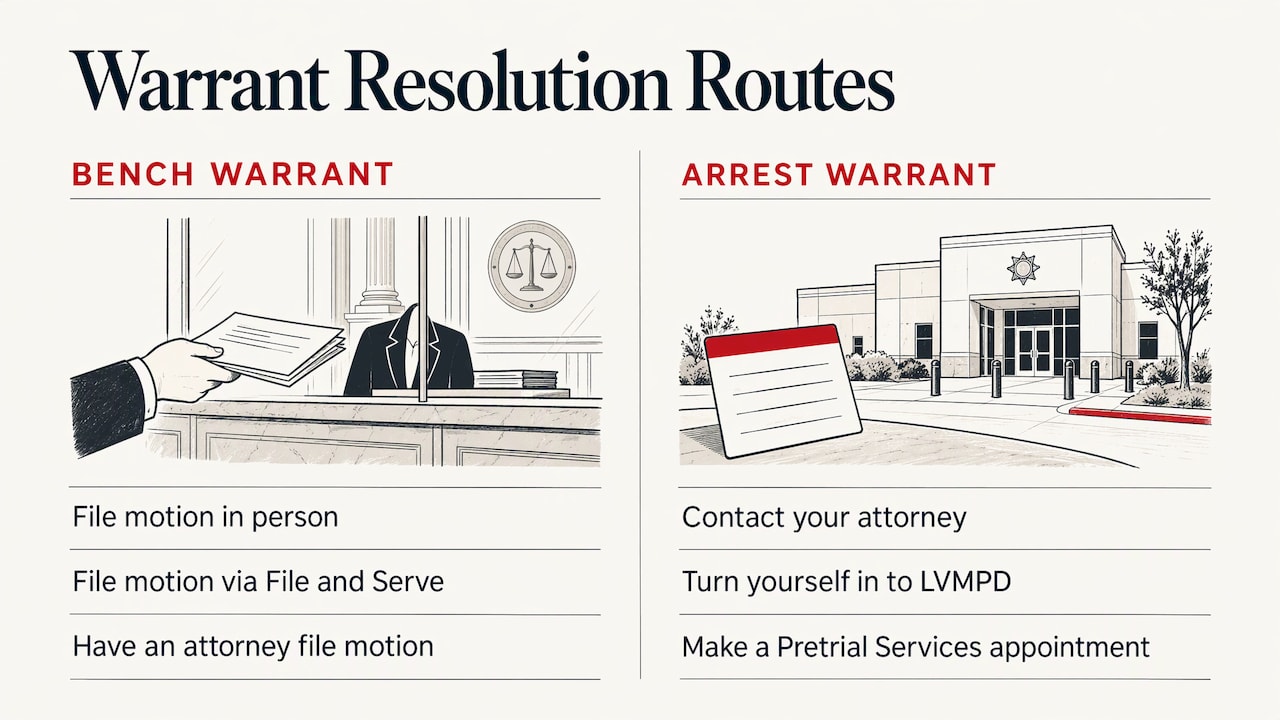
Bench warrant. A motion must be filed, either in person, online through File and Serve, or by an attorney. This is often the case when a court date was missed or a fine was not paid. Ask the clerk whether paying the fine can resolve it, as Roadmap to Reentry suggests, but speak to a lawyer before identifying yourself in person.
Arrest warrant. According to the same FAQ, you can turn yourself in to LVMPD (Las Vegas Metropolitan Police Department), contact your attorney, or make an appointment with Pretrial Services at 200 Lewis Avenue, 1st Floor, Monday to Friday, 8 a.m. to 4 p.m., (702) 455-3462. Bring valid ID such as a driver’s license, work card or military ID.
The Justice Court’s 2025 Annual Report says its Pretrial Services Division operates 24/7 and runs a Warrant Resolution Program, which lets people with outstanding arrest warrants schedule interviews and assessments so a judge can review the warrant while unnecessary arrests are minimized. In fiscal year 2025 (July 2024 to June 2025) the report records 34,135 NPRAs, 20,214 interviews and 7,146 bonds posted. In plain terms: there is a structured, scheduled way to deal with a warrant, and that is usually better than waiting to be stopped.
Why waiting rarely helps
Because warrants do not expire on their own, time does not fix the problem. Police can act on a warrant at a traffic stop, at your home or in court, and unresolved warrants can complicate jobs, housing and travel. Fines and consequences can also grow if a court date is missed. Resolving it on your terms, with a lawyer and a plan for bail, is nearly always easier than being arrested unprepared.
If someone you love may already be in custody
Sometimes the question is not “do I have a warrant” but “where did they take my family member.” The Clark County Sheriff’s FAQ says custody status can be checked online through the Clark County Detention Center, Las Vegas City Jail, Henderson Jail or North Las Vegas Jail searches. Which facility holds someone depends on who made the arrest and where. Our pages on jails and detention centers and rights after an arrest in Las Vegas explain what to expect.
When you search, have the full name and date of birth. Bail amounts are often set at or soon after booking, and some people have a hold, which delays release even if bail is posted.
When bail comes into it
If a warrant leads to an arrest, bail is the way to get released while the case goes forward. Fast Bail Bonds arranges commercial bail bonds in Las Vegas and Clark County, including warrant bail bonds, failure to appear bonds, misdemeanor, felony, DUI and domestic violence bonds. We help families locate the person in custody, understand what bail will cost and what the payment terms are, and work through the bond application and posting. Our approach is personal: we look at the specific situation rather than reading a script.
For a co-signer, the key point is responsibility. When you sign a bail bond agreement, you are agreeing to the obligations in it, including making sure the defendant goes to court and the payment terms. We walk co-signers through those terms before anything is signed. You can start on our Las Vegas bail bonds page, see all bail bond services, or read how to bail someone out.

If a family member has been arrested on a warrant and you need to understand cost and next steps, contact Fast Bail Bonds through the site.
A short checklist
- Gather your name, date of birth and any case or citation numbers.
- List the courts that could be involved based on where you were cited or arrested.
- Call those courts, or have an attorney call, and write down what you are told.
- Check the online court records, matching more than a name.
- Decide with a Nevada attorney how to handle any warrant before going in person.
- Keep ID and a plan for bail ready if you do go to a counter or Pretrial Services.
FAQ
Can I find out if I have a warrant without being arrested?
Yes. You can call the court that may have issued it, use the online court records, or have a Nevada-licensed attorney check for you. If you go in person, bring valid photo ID, and know that you may be asked to post bail.
Is there a Las Vegas active warrant list I can search?
There is no single list covering every court. Warrants are tracked by the court that issued them, so you contact the specific municipal or justice court, or use that court’s online records for case status. The Clark County DA page lists the phone numbers for each court.
How long does a warrant stay active?
Until it is served, recalled or quashed. According to Nolo, warrants do not expire on their own, and unless a court has a procedure for clearing old warrants, they can remain active for years or decades.
What should I do if I find out I have a warrant?
First learn whether it is a bench warrant or an arrest warrant, ideally with a Nevada attorney. A bench warrant generally needs a motion filed, while for an arrest warrant you can contact your attorney, turn yourself in to LVMPD or schedule an appointment with Pretrial Services. If an arrest happens, we can help with bail.
Sources
- Clark County District Attorney: Warrant status check information
- Nolo: How to Quash a Warrant
- Roadmap to Reentry: Arrest Warrants
- City of Las Vegas Municipal Court
- Las Vegas Justice Court: Criminal FAQ
- Clark County Sheriff: Frequently asked questions
- Las Vegas Justice Court: 2025 Annual Report