


A person is released from jail only through a legal authority: bail posted, a judge’s order, time served, or release without charges. Each of those has to be verified by jail staff before anyone walks out. The wait is the hard part for families, and most of it is paperwork you can prepare for. At Fast Bail Bonds in Las Vegas, we help families find an inmate, understand what bail will cost and what they are signing, and move a bond through posting. Below is the whole path, so you know what happens next and what to have in hand.
TL;DR
- Release comes in a fixed order: booking, a bail or release decision, payment or a court order, then jail processing. Each stage takes hours, not minutes.
- Bail is often set at a first appearance before a judge, usually within a day or two of arrest. Some lower-level charges have a preset bail amount.
- Even after bail is posted, release can take several hours while the jail finishes its checks.
- Anyone who signs for a bail bond, a co-signer, can be responsible for the full bond amount if the defendant misses court.
- Before paying anything, confirm the full name, booking number, charges and bail amount.
Table of Contents
- Step 1: Arrest and booking
- Step 2: Find the person and confirm the details
- Step 3: How the release decision gets made
- Step 4: Posting bail
- Step 5: What the jail does before opening the door
- How long does release take?
- If you are the co-signer
- What to have ready before you call
- Getting a bond arranged in Las Vegas
- What the process looks like when charges are dropped
- FAQ
- Sources
Step 1: Arrest and booking
Booking is the intake. Officers collect personal details, take fingerprints and photos, search the person and inventory their belongings. King County, Washington’s jail page describes the same sequence, and adds that a screener interviews the person and may contact relatives. Medical and mental health screening and a housing assignment follow. Miami-Dade County says booking can take several hours.
Two things matter to you here:
- Information is often incomplete early on. Bail and charge details may not be entered while booking is still in progress, so a call or search in the first hours can come back empty.
- Calls from the inmate are the best clue. Weber County, Utah notes that arrestees can make a collect call to arrange bail, so your phone may ring before any database updates.
Step 2: Find the person and confirm the details
Before you pay anything, confirm four facts: the person’s full legal name, their booking or ID number, the charges, and the bail amount (or whether bail is set at all). Paying for the wrong person, or before a bail amount exists, wastes money and time.
Most counties run an online inmate locator. A typical one, like San Bernardino County’s, searches by booking number or by name plus date of birth, and can show the arrest date, bail amount, housing facility and projected release date. Some records are legally withheld from public sites, so a missing name does not always mean the person is not in custody. In that case you call the facility directly. New York City’s lookup guidance adds that people arrested in the past 72 hours may still be in police custody and not yet in the jail system.
In Las Vegas, the person will usually be held at the Clark County Detention Center. If you cannot locate them, we can help you track down the custody information.
If you want to understand what court and criminal records generally show about a person, what shows up on a background check explains how county, state and federal records differ. That is useful when the charges on the screen are not what you expected.
Step 3: How the release decision gets made
Nobody is released just because the family asks. One of these has to happen:
| Release route | What it means |
|---|---|
| Posted bail | Cash or a surety bond is paid to the court or jail |
| Release on own recognizance (O.R.) | A judge releases the person on a promise to appear, based on ties like address, work and family |
| Release with conditions | Supervision, no-contact orders, monitoring or similar terms |
| Charges not filed | The person is released without conditions after a holding period |
| Time served or sentence complete | The case or sentence is finished |
Kern County, California’s release policy lists the legal authorities for release as time served, posted bail, court release, program release or statutory release.
The first appearance
For many charges, bail is not set until a judge sees the person. Timing varies by state. King County, Washington says a judge must see the person within 48 hours, and Minnesota’s courts guidance sets 36 hours, excluding Sundays and holidays. At that hearing the judge can release the person without conditions, release with conditions, or set bail.
Families can influence this stage. King County says showing up to the first appearance can make a big difference, since many judges allow relatives to speak about the person’s job, stability and community involvement. The ACLU of San Diego suggests bringing a one-page summary for the defense lawyer with contact details, family members and residence history. The defendant’s own lawyer is the right person to argue for release at the hearing.
Step 4: Posting bail
Once bail exists, there are two main ways to pay it.
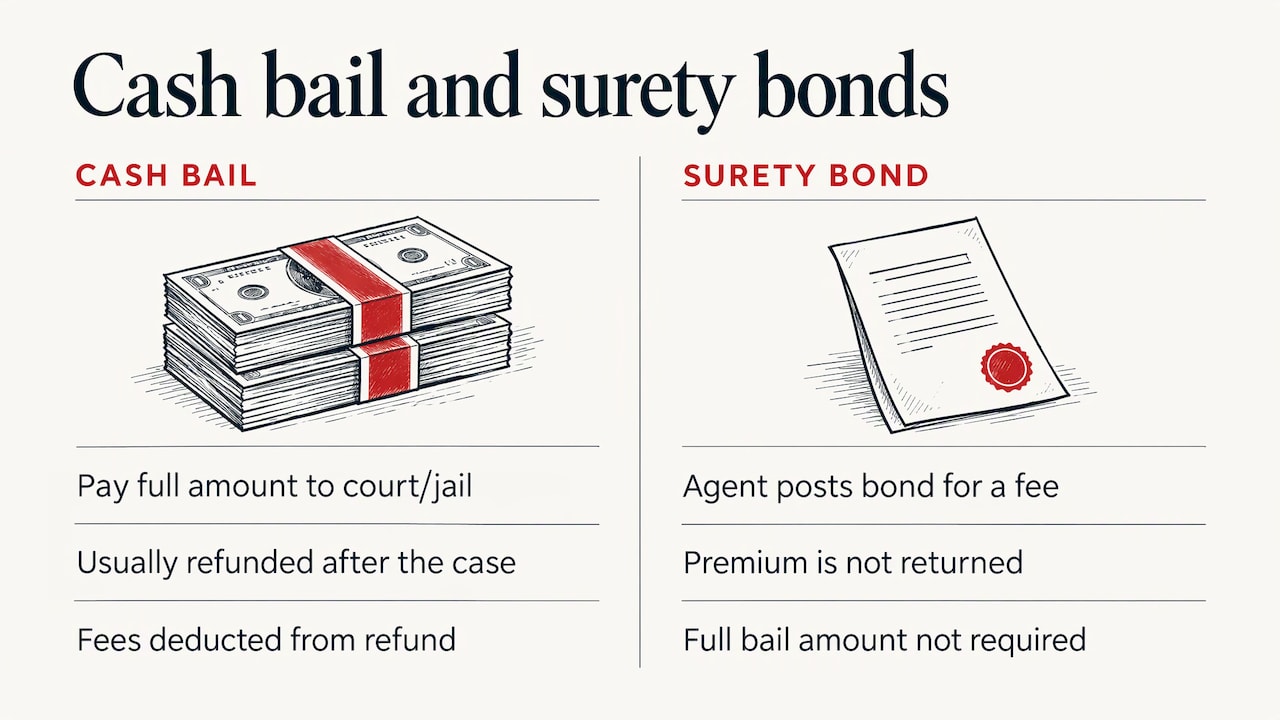
Cash bail. You pay the full amount to the court or jail. It is generally returned at the end of the case if every court date is kept, minus any fees. The ACLU of San Diego notes this is different from a bond premium, which is not returned.
A surety bail bond. A licensed bail agent posts the bond for a fee, called the premium, so you do not need the whole amount. Miami-Dade County describes a bond posted by a licensed agent for a fee as the alternative to paying cash. Our pages on bail versus bond and cash bail versus a bail bond premium in Nevada walk through the difference.
Posting at the Clark County Detention Center
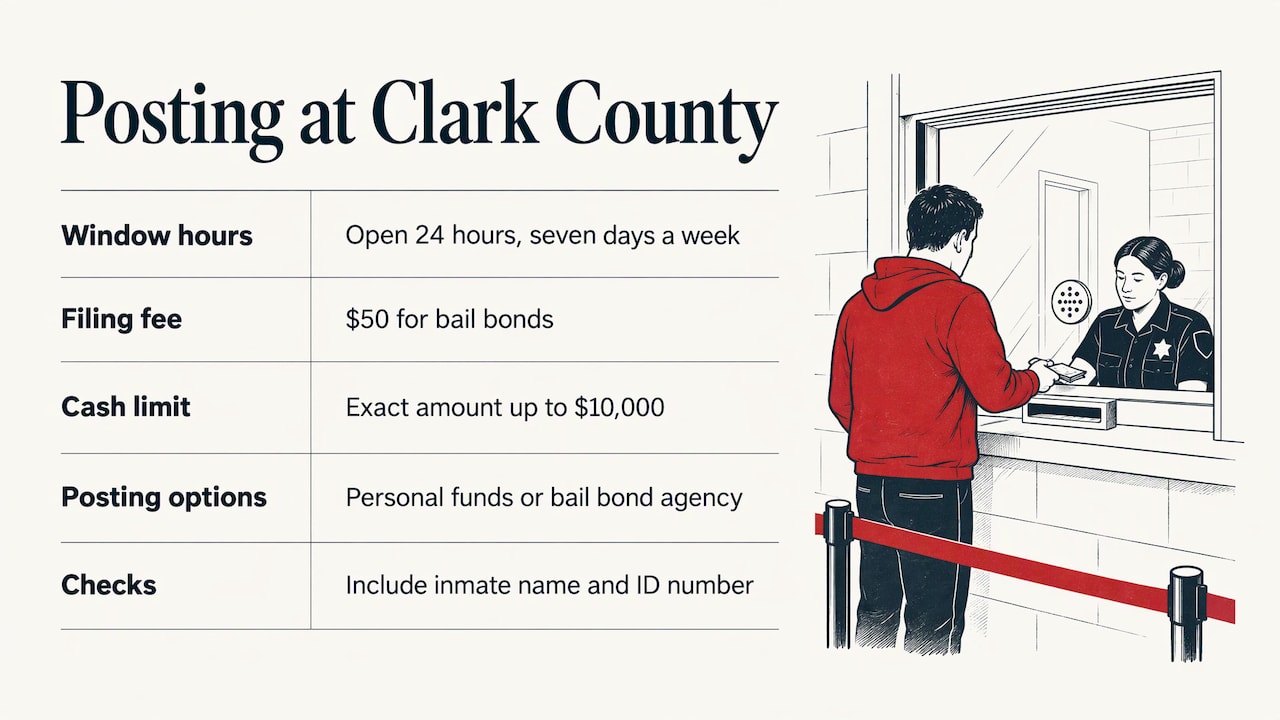
Clark County’s official bail page says the Pre-Trial Services bail window inside the Detention Center is open 24 hours a day, seven days a week. It also says a $50 filing fee applies to bail bonds, and that family members or representatives can post bail with personal funds or go through a bail bond agency. Cash is accepted in the exact amount up to $10,000, and the inmate’s name and ID number go on any check or money order.
For the steps to take as the person paying, see our guide on how to bail someone out. If the charge is a DUI or a felony, the bail amount and conditions can differ a lot, and we handle both: DUI bail bonds and felony bail bonds.
Step 5: What the jail does before opening the door
Posting bail does not release the person on its own. Jail staff still have to process the release. Kern County’s policy is a good picture of what that involves:
- Clerical staff verify the legal basis for release and process the file.
- A supervisor authorizes the release.
- The person’s identity is confirmed by fingerprint and file details.
- The jail checks for outstanding warrants.
- Property and funds are returned and the person signs paperwork.
A hold from another agency or an unrelated warrant can stop a release even when bail is paid. San Bernardino County also states that posting bail does not guarantee release if a charge is marked “no bail” or “sentenced”. Always look for these flags when you check the booking record.
How long does release take?
Expect hours. Local rules differ, but some published examples show the range:
- Volusia County, Florida says release paperwork can take 2 to 4 hours once it starts. Since April 29, 2024, people there are not released between 10 p.m. and 6 a.m. unless someone is on site to transport them.
- Allegheny County, Pennsylvania says bonded inmates are typically released within three hours of the jail receiving the documents. Without a bond, the jail has up to 48 hours from a court release order.
- Weber County, Utah says court-released inmates go out from about 5 p.m. and time-served inmates from about 9 a.m.
The pattern is clear: how fast release happens depends on the facility’s schedule, the shift, and how quickly your paperwork reaches the right desk. Facility procedures change, so ask the facility itself for its current release hours and pickup rules. For Las Vegas, that is the Clark County Detention Center.
If you are the co-signer
When a bond is arranged, a family member or friend often signs the bond agreement alongside the defendant. That person is the co-signer, also called an indemnitor. Read the agreement before you sign it. These are the main points the published guidance flags:
- You can owe the full bond amount. The ACLU of San Diego states that if the person misses court, anyone who signed is responsible for the full bail amount, and pledged property can be taken.
- The premium is typically not refunded. The same brochure says a bond fee, usually 10% of bail in that example, is non-refundable even if charges are dropped or the person is released at arraignment. LawHelp Minnesota says the same of a usual 10% fee in that state. Premium rates are set by state law and differ by state, so ask for the rate in writing in Nevada.
- The contract can reach beyond the bond. A UCLA Criminal Justice Reform Clinic report on California bail contracts found that co-signers can be liable for costs from the defendant’s breaches, such as investigation expenses, and may be asked to help return the defendant to custody.
- Contact terms matter. LawHelp Minnesota notes some contracts allow the company to track the signer’s vehicle or job status, and that signers can get repeated calls and texts.
The best protection is understanding all of this before you sign, and the best protection afterward is making sure the defendant makes every court date. Our co-signer responsibilities page covers the obligations in plain terms. We also answer the question whether a co-signer can cancel a bond if the defendant misses court.
What to have ready before you call
- The person’s full legal name and date of birth.
- Their booking or inmate ID number, if you have it.
- The charges and bail amount from the locator or the jail.
- Your own government ID, plus proof of income or employment if you will co-sign.
- A way to be reachable at all hours, since release timing is driven by the jail.
- The next court date, which you will need to keep track of after release.
Getting a bond arranged in Las Vegas
We write commercial bail bonds across Las Vegas and Clark County for DUI, felony, misdemeanor, domestic violence, failure-to-appear and probation violation cases. Our approach is case-specific: we explain what your family’s situation means for the cost, the paperwork and the co-signer’s obligations, rather than reading from a script.

If someone you love is in custody, start with our bail bond services in Las Vegas. We also serve Las Vegas and North Las Vegas specifically.
What the process looks like when charges are dropped
A bond premium is a fee for the service of posting the bond, which is why it is generally not returned even when the case ends early. We explain this in what happens to your premium if charges are dropped in Nevada. Cash bail is treated differently, and our page on whether you get bail money back when charges are dropped covers that.
FAQ
How long does it usually take to get someone out of jail?
Usually several hours after bail is posted, and longer if booking is unfinished or a bail amount has not been set. Published examples range from 2 to 4 hours of paperwork in Volusia County, Florida to up to 48 hours after a court release order in Allegheny County, Pennsylvania, with bonded inmates typically out within three hours. Ask the facility about its own timing.
How does jail booking work?
Booking is the intake: personal details are recorded, the person is fingerprinted, photographed and searched, and property is inventoried. Health screening and housing classification follow, and bail is entered when it applies. It can take hours, according to Miami-Dade County.
Can you refuse to be released from jail?
Rules vary by jurisdiction and the person’s legal situation, and a defendant’s lawyer is the right person to advise on it. In practice, release has to follow a legal authority, so the jail does not release someone simply because the family wants it. The defendant should also understand that release usually comes with court dates and conditions.
Does posting bail guarantee release?
No. Holds, warrants from other agencies, or charges marked as no bail can keep a person in custody. Check the booking record for these flags before paying.
Sources
- Kern County Sheriff’s Office release policy C-850
- King County, Washington: if your loved one is in jail
- Weber County Sheriff: booking and release
- San Bernardino County Inmate Locator
- NYC311: Incarcerated Person Location and Information
- Miami-Dade County: what happens after an arrest
- LawHelp Minnesota: I got arrested, what happens now
- ACLU of San Diego arrest brochure
- UCLA Criminal Justice Reform Clinic report on bail bond contracts
- Volusia County corrections FAQ
- Allegheny County Jail release process
- Clark County Pre-Trial Services and bail