


Yes, a relative or friend in another state can usually co-sign a commercial bail bond for someone held in Las Vegas. The co-signer (the bail industry calls this person the indemnitor) does not have to stand in the jail lobby. What matters is that the person can be identified, can sign the paperwork in a form the bond agent accepts, and can carry the financial promise. At Fast Bail Bonds we walk co-signers through the paperwork and their responsibilities, so the first call can happen from anywhere.
This guide is for families deciding whether to co-sign from a distance. It covers what an out-of-state co-signer signs, how signing at a distance usually works, what the signature can cost, and when the obligation ends.
TL;DR
- Commercial bail bonds generally do not require the co-signer to live in the same state as the defendant. Court-ordered bonds are different, because a judge decides who qualifies.
- A co-signer who is far away typically proves identity with a government photo ID. Signatures given away from the agent are often notarized, depending on the state’s rules.
- Co-signing is a financial guarantee. If the defendant misses court, the co-signer can be liable for the full bond amount plus recovery costs.
- Nevada’s premium is set by statute, as the research below shows. Ask for every charge beyond the premium in writing before you sign.
- Collateral comes back only after the bond liability has ended, so ask what ends it.
Table of Contents
- Why the co-signer’s state is rarely the problem
- Two situations that look alike and are not
- How signing from another state usually works
- What you are promising when you co-sign
- What it costs, and which charges to ask about
- When your obligation ends
- Getting set up for a Las Vegas bond
- FAQ
- Sources
Why the co-signer’s state is rarely the problem
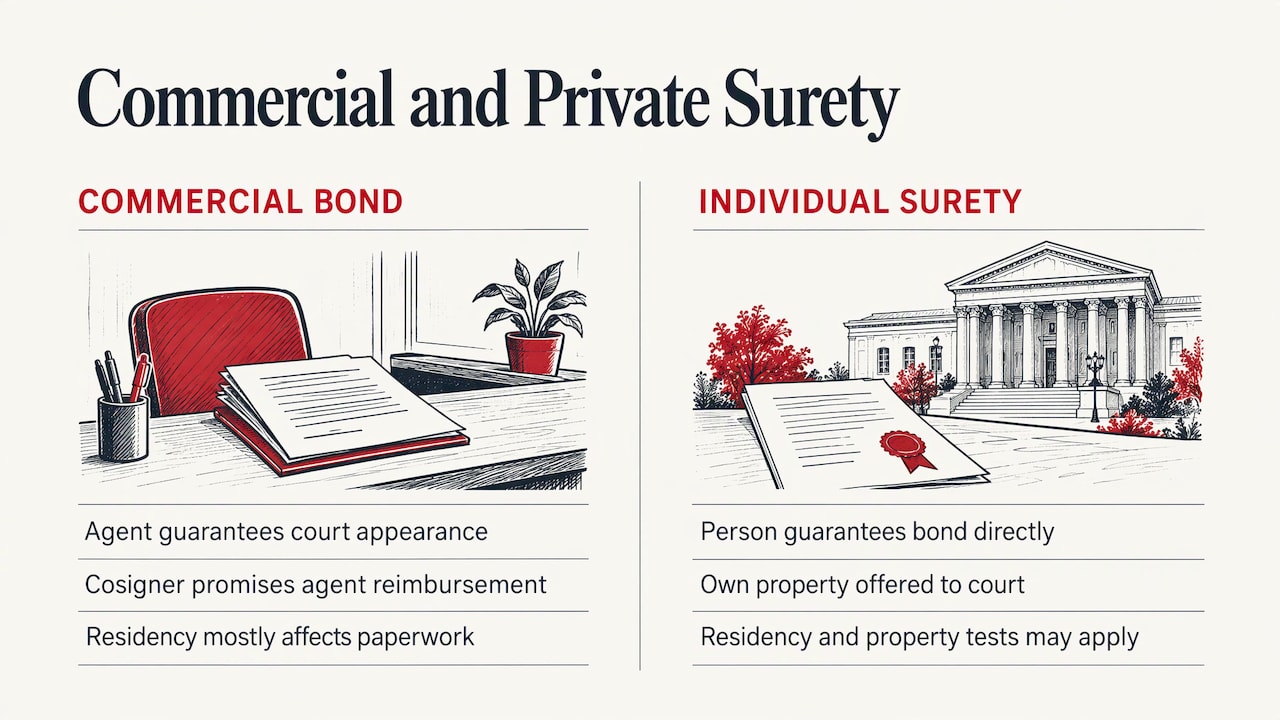
Search results for this phrase are dominated by car loans, where lenders ask about residency and title. Bail works differently. In a commercial bond, a licensed agent pays the court a guarantee that the defendant will appear. In return, the agent charges a premium and asks someone to promise to reimburse the agent if things go wrong. That promise is the indemnity agreement, and the person who makes it is the co-signer.
The agent’s questions are practical: Who are you? Can we reach you? Can you pay or back the bond with something of value? Where you live matters mostly for paperwork logistics. A person across the country cannot walk into an office, so the signing has to happen another way.
Residency rules do exist, but they apply in other settings. Some states set residency requirements when an individual, rather than a company, offers to act as surety (the party who guarantees the bond). South Dakota, for example, requires a natural-person surety to be a bona fide state resident for the preceding year and to hold record title to acceptable property in the state, under SDCL chapter 58-22. Oklahoma’s bail statutes set a similar residency and property test for individuals. Those rules concern private persons putting up their own property directly with the court. They are not the same as co-signing a commercial agent’s indemnity agreement, but they show why you should always ask which kind of bond is being discussed.
Two situations that look alike and are not
A commercial bond through a licensed agent
This is the usual route after a Las Vegas arrest. The agent posts the bond, the family pays a premium, and the co-signer signs the indemnity agreement. Our page on how bail works explains the money flow, and bail versus bond explains why paying a premium is not the same as paying the court.
A surety approved by a judge
In some cases, particularly federal ones, a judge decides who may sign. A federal district court handout explains that at a formal bail hearing the presiding judge may order co-signers to sign the appearance bond, and that co-signers must show identification such as a driver’s license, passport or alien registration card. The Western District of New York says a solvent surety it approves must be present at the hearing to sign the bond with the defendant in the judge’s presence. In that setting, being out of state is a real obstacle. If the case is in federal court or a judge has ordered a particular surety, tell the agent at the start.
How signing from another state usually works
What counts as a valid signature varies by state, and the state that matters is generally the one where the bond is written. Arkansas offers a clear example: its bail bond law says that signatures of principals and indemnifiers not given in the bondsman’s presence must be notarized. Other states have their own rules, so do not assume that what worked for a car loan will work for a bond.
Here is the sequence most families follow.
- Get the facts on the defendant. You need the full legal name, date of birth and the facility holding the person. If you only know the person was arrested in Clark County, we can help you locate the inmate and find the bail amount.
- Call a Nevada bail agent before you gather anything. The agent tells you which documents the paperwork requires and what forms of signing it accepts. Doing this first avoids a second round of signing because a page was done incorrectly.
- Prepare identification. Expect to show a valid government photo ID. Have your address and phone number ready, because the agent needs a reliable way to reach you.
- Choose the signing method. Typically this is a notary near you, an electronic signing platform or a document exchange, depending on what the agent and the governing state accept. Ask which one applies before you pay a notary.
- Handle the money. The premium and any collateral are arranged in the same conversation. Our financing options page covers payment terms.
- Keep copies of everything. You will want the signed agreement, the receipt and the itemized list of any fees beyond the premium.
Where does this go wrong? Most delays come from three things: a notary stamp that does not match the signature, a missing ID page and a co-signer who cannot be reached when the agent calls back. A defendant stays in custody while those are fixed, so answer the phone on the day of the arrest.
If the person arrested is a visitor to Nevada and the family is somewhere else entirely, our guide on remote bail bonds for tourists is written for exactly that case.
What you are promising when you co-sign
The signature is not a character reference. It is a contract. A typical indemnity agreement makes each co-signer jointly and severally liable for losses, fees and expenses arising from the bond. “Jointly and severally” means the agent can pursue any one co-signer for the whole amount, not just a share. Our co-signer responsibilities page lays out the usual duties, including making sure the defendant gets to court.
The worst case is a missed court date. The Northern District of California’s official bond form says that if release conditions are not followed, the full bond amount is due, posted cash or property is forfeited, and judgment may be entered against the defendant and all sureties jointly and severally. A commercial agreement works through the agent rather than the court, but the logic of shared liability is the same.
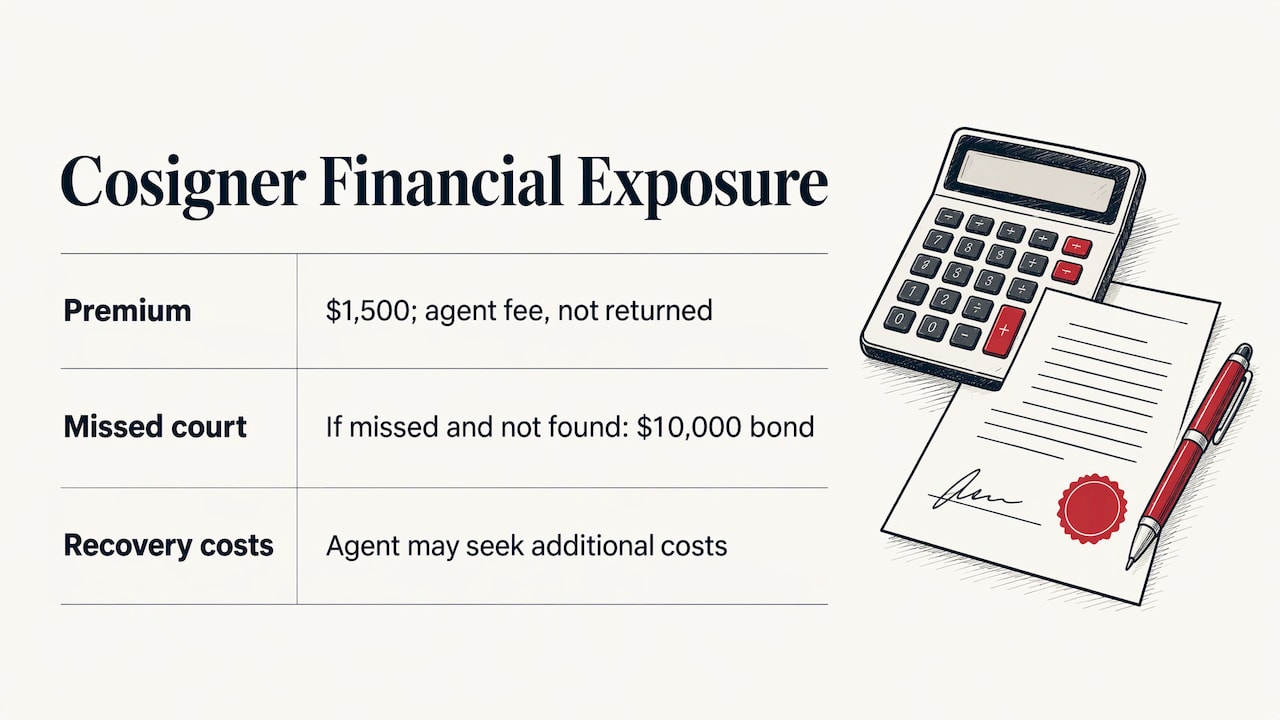
A worked example makes it concrete. Say bail is set at $10,000. Under the 15% premium discussed below, the premium would be $1,500. That money is the agent’s fee and is not returned. If the defendant then misses court and cannot be found, the agent may look to the co-signer for the $10,000 bond amount and for the costs of recovery. The $1,500 and the $10,000 are separate obligations. If you want to see how your own number would look, use our bail calculator and read bail costs and premium.
Distance adds one more risk: you cannot see the defendant. Before signing, talk with the defendant about court dates and the release conditions, and agree on who will remind them. If the defendant does miss court, read what happens next in our pages on whether a co-signer can cancel a bond and what happens when someone skips court.
What it costs, and which charges to ask about
Premium rates are regulated, and the state of the arrest decides the rate. A National Conference of State Legislatures summary of state practice lists Nevada’s premium under NRS 697.300 as “$50 or 15%, whichever is greater”, the same formula it lists for Colorado. That document dates from 2013, so confirm the current wording of the statute before relying on it, and ask the agent to state the premium in dollars before you sign.
Premium is not the only possible cost. A University of California, Los Angeles law review of California bail contracts, published by the Prison Policy Initiative, found that indemnitors were routinely held liable for the full bond amount plus recovery expenses, with fee schedules that varied widely between contracts. That is a California study, and Nevada’s rules are its own, but it points to the right habit for any co-signer: read the clause on expenses.
A short list of questions to settle in writing:
- What is the premium, in dollars, and is it payable in installments?
- Is collateral required, what is it, and how is it returned?
- Which charges, if any, apply beyond the premium, and when?
- Who is on the agreement besides you?
- What exactly ends the agent’s liability on the bond?
As for collateral, South Dakota’s statute is a useful illustration of the general principle: collateral must be reasonable in relation to the bond amount and returned when liability on the bond finally ends. Ask the same question in Nevada about your own agreement. If you will pledge a car, a title or a deposit from another state, say so at the start so the agent can explain how it is held.
When your obligation ends
The obligation does not end when the defendant is released, and it does not end at the first court date. It ends when the bond is discharged, typically when the case is resolved or the court otherwise releases the bond, and the agent confirms the liability is over. Collateral should come back only after that, along with any related paperwork the agreement calls for.
Two habits protect an out-of-state co-signer. First, keep in touch with the defendant through every hearing, since you cannot check in person. Second, ask the agent for written confirmation when the bond is discharged, then keep it with your copy of the agreement.
Getting set up for a Las Vegas bond
If your family member is held in Clark County and you are across the country, the fastest way to find out what is possible is to talk with an agent about your specific case: the charge, the bail amount, your location and who else could sign. At Fast Bail Bonds we give co-signers case-specific guidance on bail costs, bond paperwork and financial responsibilities, rather than scripted answers, and we write bonds for felony, DUI, misdemeanor, domestic violence, failure-to-appear and probation violation charges.

Start on our bail bond services page or reach us through the Las Vegas bail bonds home page. If you want the full sequence first, how to bail someone out and our step-by-step surety bond guide cover it.
FAQ
Can someone who lives in another state co-sign a bail bond?
In most commercial bond situations, yes. The agent needs to verify your identity, reach you and arrange a signature the governing state accepts. If a judge has ordered a specific surety, as in some federal cases, the court may require the surety to appear in person.
Does an out-of-state co-signer need a notary?
Often, when the signature is not given in front of the agent. Arkansas law, for example, requires notarization of signatures not given in the bondsman’s presence. Ask the Nevada agent which signing method applies to your agreement before you pay for a notary.
What is an out-of-state co-signer responsible for if the defendant misses court?
A co-signer can be liable for the full bond amount and for recovery expenses named in the agreement. With more than one co-signer, each can be liable for the whole sum. Read the expenses clause and ask for a written list of any charges beyond the premium.
What if no one in the family can co-sign?
Tell the agent who is available and what they can offer, such as income, property or collateral. Different people can sometimes share the obligation, and our financing options page explains how payment terms can work.
Sources
- Federal court handout on appearance bonds and co-signer identification (D.N.J., 2007)
- Bail bonds pamphlet, U.S. District Court, Western District of New York (revised 10/2024)
- Arkansas Code § 17-19-106 and bail bond chapter
- Order Setting Conditions of Release and Appearance Bond, N.D. Cal. (2023)
- South Dakota Codified Law chapter 58-22
- Oklahoma Insurance Department, bail bond statutes (2021)
- NCSL, Bail Bond Agent Business Practices (2013)
- UCLA Law review of California bail bond contracts, via Prison Policy Initiative (2017)