

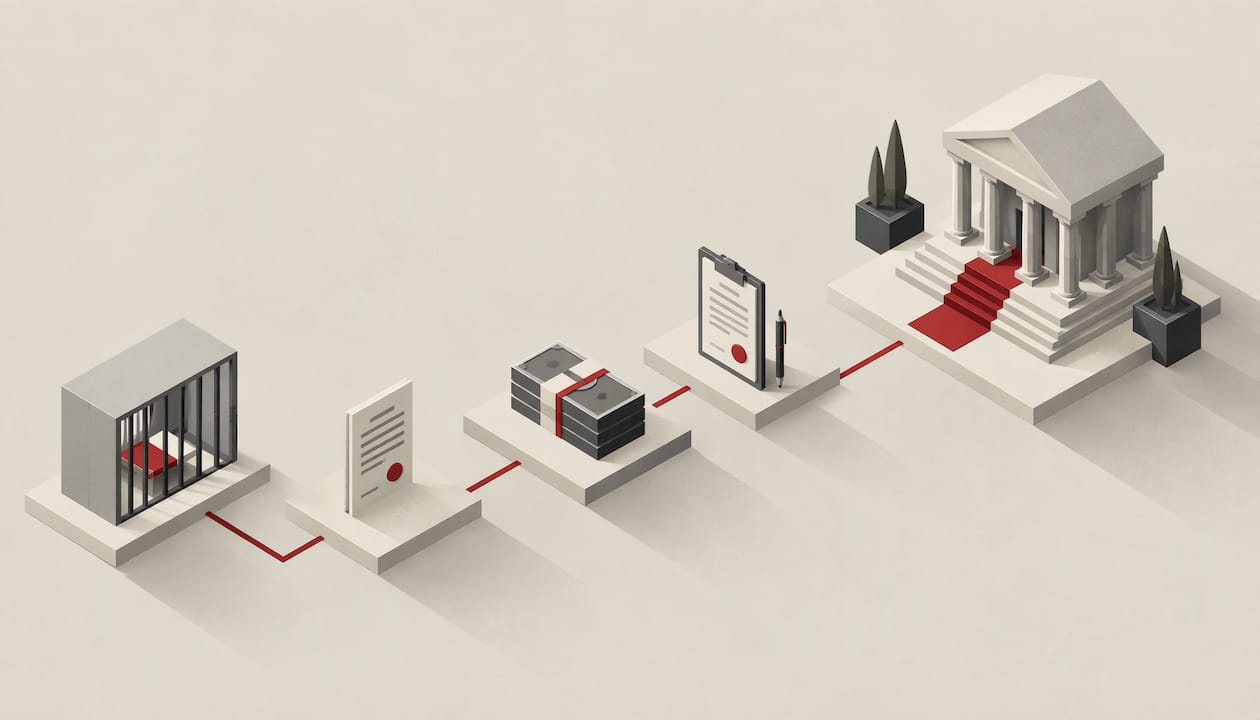
A surety bail bond is a three-party promise: a bonding company guarantees to the court that the defendant will appear at every hearing, and the family pays a fee and signs a financial agreement so the person can go home while the case proceeds. The process runs in a fixed order: confirm the bail amount, sign the agreement, pay the premium, let the bond go to the court, and wait for release. Where families get hurt is in the agreement they sign along the way. At Fast Bail Bonds in Las Vegas, we walk families and co-signers through each of those points for their specific case in Clark County.
TL;DR
- A surety bail bond involves the court, the defendant and the bonding company. The family member who signs is a fourth party, the co-signer (also called the indemnitor).
- The steps: find the person and the bail amount, sign the agreement, pay the premium and any collateral, the bond is filed with the court, and the jail processes the release.
- The premium is the fee for the bond. In Nevada, state law sets bail rates at 15% of the bond or $50, whichever is greater.
- A co-signer is on the hook for the full bail amount if the defendant misses court or breaks the contract terms.
- Read the whole agreement before signing and ask for a written receipt for any collateral.
Table of Contents
- What a surety bail bond actually is
- Step 1: Find the person and confirm the bail amount
- Step 2: Understand what you are about to sign
- Step 3: Pay the premium and arrange collateral
- Step 4: The bond goes to the court
- Step 5: Release from custody
- What a co-signer owes if something goes wrong
- How the process differs by place
- Getting a bond arranged in Las Vegas
- FAQ
- Sources
What a surety bail bond actually is
Bail is the money or guarantee a court requires before it lets a person out of jail while the case is pending. A bail bond is a way to meet that requirement without paying the full amount yourself. The Florida Department of Financial Services describes a bail bond as a type of surety bond: a three-party guarantee among the party requiring the bond (the court), the person who must perform (the defendant), and the surety (usually the bonding company). A fourth party, the indemnitor, often joins. That is the co-signer.
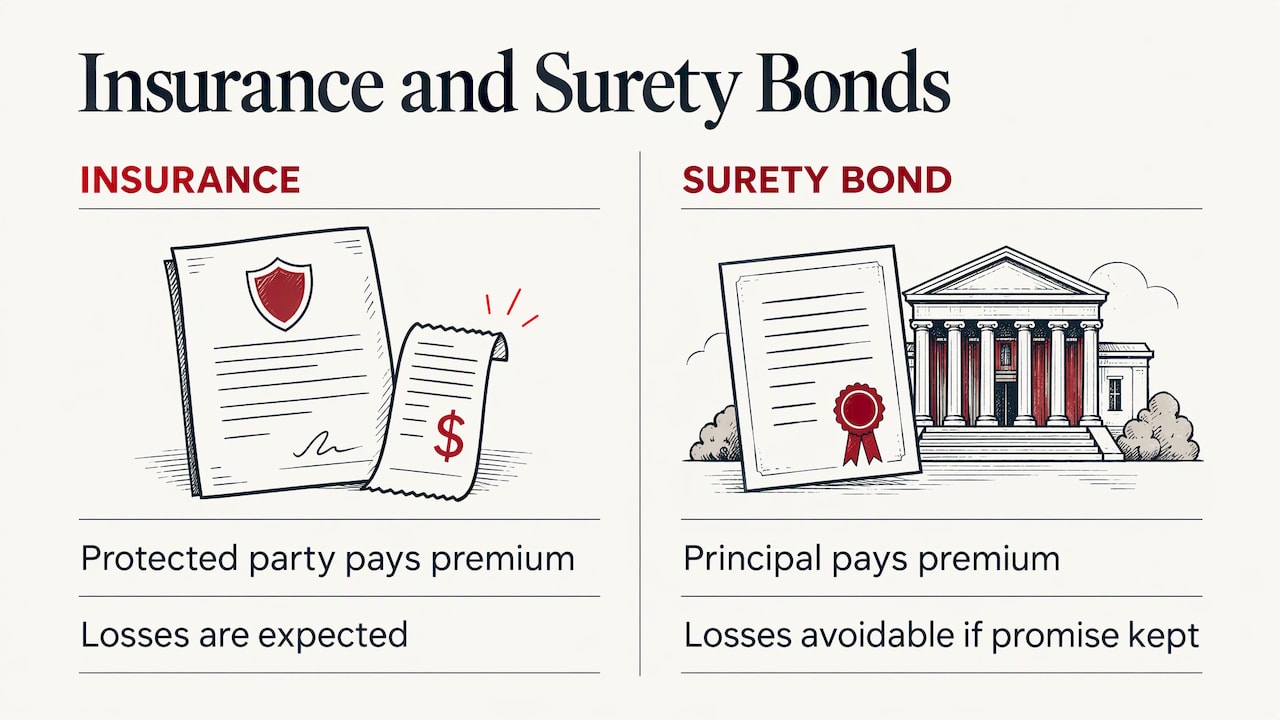
This is why a bail bond is not like car or health insurance. A U.S. Department of Justice report explains that in insurance the protected party pays the premium and losses are expected, while in suretyship the principal pays the premium and losses are assumed to be avoidable, because they happen only when the principal fails to keep the promise. The practical meaning for a family: the company is not absorbing a risk for you. It is lending its name and credit to the court, and it expects you to stand behind that promise.
If you want the vocabulary in more detail, our page on bail versus bond covers it.
Step 1: Find the person and confirm the bail amount
Before you call anyone about a bond, you need three facts: the person’s full legal name, their booking or jail number, and the bail amount. Jails publish these through online inmate lookups and information desks, and the amount may not appear right away. Miami-Dade’s corrections department notes that bond information may not be available immediately while booking is in progress, and booking can take several hours. Las Vegas works the same way in practice: a person is booked first, and the amount follows.
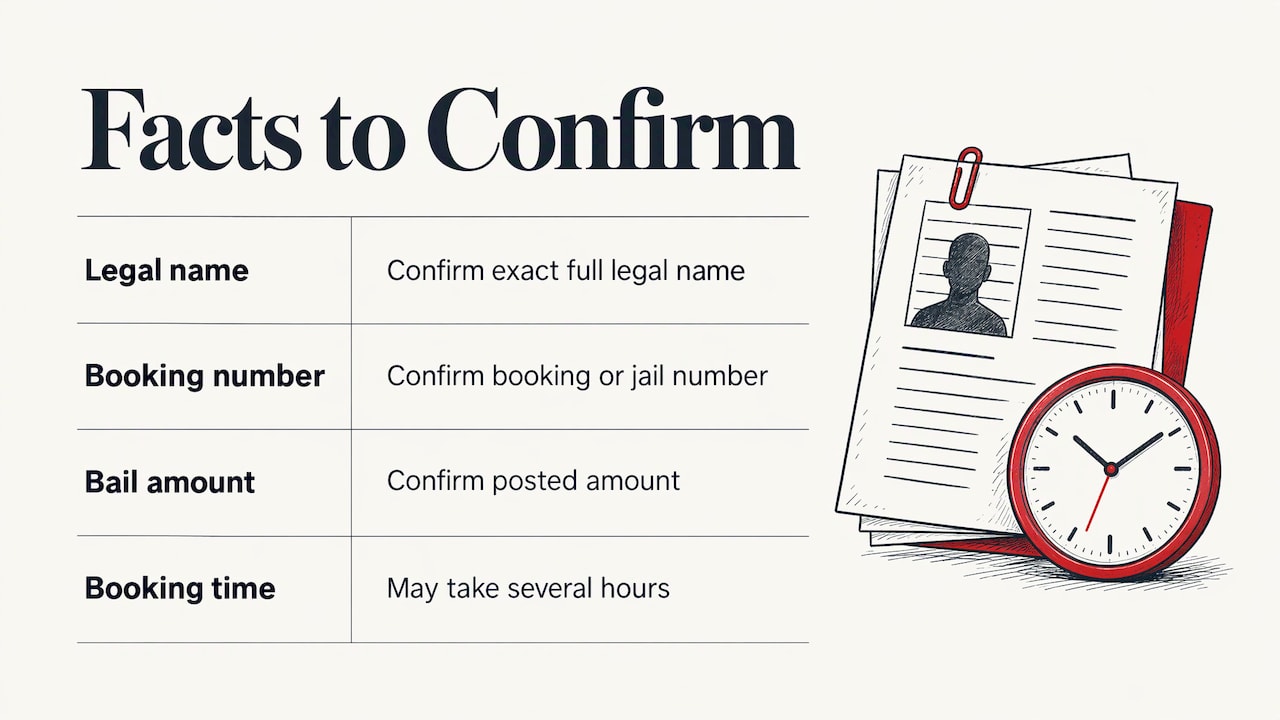
What goes wrong here: families call with a nickname, a misspelled surname or a guess at the charge, and the lookup returns nothing. Some people are also held without a bail amount until they see a judge, and a bond cannot be written until a number exists.
This is a step where we help directly. Finding the inmate record and understanding the bail amount are part of the guidance we give families in Clark County, so you do not have to decode the jail’s system alone while you are upset.
Step 2: Understand what you are about to sign
The core document is the indemnity agreement, sometimes called a bail agreement. The New York Department of Financial Services describes it as a contract between friends or family and a licensed bail agent, who then guarantees the full bail to the court. By signing it, the co-signer promises to cover what the bonding company pays out if the defendant does not appear.
Before anyone signs, check these points:
- Who is the defendant and what is the total bail? The bond amount should match what the jail shows.
- What is the premium, in dollars? It should be a number written on the page, not a range.
- Is collateral required? Collateral is property or money pledged as security, such as a car title or a deposit.
- What are the payment terms? If the premium is paid in installments, the schedule and any fees should be on paper.
- What are the defendant’s obligations? Court dates, check-ins and any conditions of release.
Take the documents home or read them in full before you sign. New York City’s consumer bill of rights for bail bonds gives people the right to take documents off the premises to review them before signing. That is a New York rule, but it is a sound habit anywhere: nobody should sign a financial guarantee in a hurry because someone is pressing them.
Our co-signer responsibilities guide lists what a signer commits to. When you work with us, we go through the specifics of your agreement with you, so you know your obligations before you sign.
Step 3: Pay the premium and arrange collateral
The premium is the fee for the bond. It is a percentage of the bail amount, and it is not a deposit toward the bail. Rules differ by state:
| State | Premium rule | Source |
|---|---|---|
| Nevada | 15% of the bond or $50, whichever is greater | NRS Chapter 697 |
| Florida | 10% of the bail for a state bond, 15% for a federal bond | Florida DFS |
| New York | Capped on a sliding scale, with 10% on the first $3,000 | NY DFS |
A worked example in Nevada: on a $10,000 bail, a 15% premium is $1,500. The bail is not what you pay up front. You pay the premium, and the bonding company posts the bond for the whole $10,000. Our bail costs and premium page and bail calculator let you work out the number for your own bail amount, and the financing options page explains how payments can be arranged.
Two points on money trip people up:
- The premium is generally not refunded. The Florida agency says it is nonrefundable once the bondsman takes the defendant out of jail, and New York’s regulator also describes it as generally non-refundable. Charges being dropped later does not automatically change that. We cover the Nevada side in what happens to your premium if charges are dropped.
- Cash bail and a premium are different things. With cash bail, the money goes to the court and is generally returned at the end of the case. A premium is a fee you do not get back. Our explainer on cash bail versus a bond premium in Nevada draws the line.
If collateral is taken, ask for a written receipt that describes it fully. Nevada’s bail statute covers written receipts for collateral on acceptance, and keep that paper until the bond ends.
Step 4: The bond goes to the court
Once the agreement is signed and the premium paid, the agent files the bond with the court. The ACLU describes this as a legal promise to pay the bail in full if the court declares the bond forfeited, which can be triggered by a failure to appear. Most agents are backed by an insurance company acting as the surety.
In some courts a federal case adds a formal step. In federal criminal matters, a surety must sign the appearance bond in the judge’s presence at the bail hearing and both are told their obligations. Most local cases are simpler, but the principle holds: the court has to accept the bond.
Step 5: Release from custody
After the bond is accepted, the jail completes its release procedure. It checks identity, runs a warrant check, tells the person the court date and has them sign release paperwork. How long this takes depends on the facility and how busy it is. One Texas county sheriff’s guide says the book-out process usually takes 1.5 to 3 hours. Expect that kind of window after the bond is filed, and longer if the jail is processing many people.
Our how to bail someone out page gives the practical walk-through for the Las Vegas area, and how bail works covers the general structure.
What a co-signer owes if something goes wrong
This is the part that matters most to the person holding the pen. The ACLU’s report says family co-signers guarantee that they will pay the full bail amount if the person fails to appear or violates the contract terms, and agents often require property or other assets as collateral. The insurer is on the hook only as a last resort. The person who signed is first in line.
In practice that means:
- If the defendant misses court, the court may revoke bail and declare the bond forfeited. The co-signer can lose pledged collateral, as New York City’s bill of rights puts it: the bond is forfeited and the collateral is lost.
- If the case ends normally, the court exonerates the bond, which releases the obligation. Collateral should then be returned. New York’s rules require that collateral be returned within 45 days of notice of exoneration. Keep your receipt and the court’s disposition paperwork to prove the case is over.
- A missed date is not always the end. Talk to your bond agent the moment you learn about it, because options may exist before a forfeiture becomes final. Our page on whether a co-signer can cancel a bond after a missed court date explains what is and is not possible.
If you are deciding whether to co-sign, ask yourself honestly whether the defendant will go to every hearing, and whether you can afford to lose what you have pledged. For questions about your legal exposure in a specific case, a licensed attorney is the right person to ask. We can explain the bond paperwork and your financial responsibilities under it.
How the process differs by place
Bail law is set state by state, and sometimes county by county. Premium caps, collateral rules and release procedures all vary, which is why a general guide cannot replace local knowledge. Rules also change. Florida lawmakers took up a 2026 bill that would change cash payment forms and bond agent training, and Texas voters approved a constitutional amendment that now lets judges deny bail for certain offenses after a hearing. Anything you read from another state is a guide to the shape of the process, not to the rules in Clark County.
Getting a bond arranged in Las Vegas
We write bail bonds in Las Vegas and across Clark County, including DUI, felony, misdemeanor, domestic violence, failure-to-appear and probation violation bonds. We help you locate the inmate, understand the bail amount and the cost, and move through the application and posting. Our approach is to give families and co-signers case-specific guidance on custody information, costs, paperwork and their financial responsibilities, rather than a scripted answer.

If someone you love is in custody now, start with our bail bond services page, or go to the Las Vegas bail bonds page to reach us.
FAQ
Is a surety bond the same as a bail bond?
A bail bond is one kind of surety bond. Both are three-party guarantees, but a bail bond guarantees a defendant’s court appearances, while other surety bonds guarantee things like a license or a contract. The key difference for families is that a bail bond has a co-signer who backs the company’s promise with their own finances.
How much does a surety bail bond cost in Nevada?
Nevada’s bail statute sets the rate at 15% of the bond or $50, whichever is greater. On a $5,000 bail, that is $750. The premium is the fee for the bond, so it is separate from the bail amount itself.
Do I get the premium back?
Generally no. Regulators in states such as Florida and New York describe the premium as nonrefundable once the defendant is released. Collateral is different: it is returned when the bond ends without a forfeiture.
What happens if the defendant misses court?
The court can declare the bond forfeited, and the co-signer becomes responsible for the bail amount and may lose pledged collateral. Contact the bond agent immediately, because acting quickly can affect the outcome.
Sources
- Nevada Revised Statutes, Chapter 697, Businesses Related to Bail
- Florida Department of Financial Services, Bail Bonds Overview
- U.S. Department of Justice, Commercial Bail Bonding: How It Works
- Miami-Dade Corrections, What Happens After an Arrest
- New York DFS, Bail Information for Consumers
- NYC Bail Bond Consumer Bill of Rights
- ACLU, Selling Off Our Freedom
- U.S. District Court, W.D.N.Y., Bail Bonds pamphlet
- Fort Bend County Sheriff’s Office, Explanation of Bonding Process
- NYSDFS Regulations, 11 NYCRR Part 28
- Florida Senate, SB 600 Bill Analysis
- Texas District & County Attorneys Association, The dawn of a new day in Texas bail