


A traffic bond is money or a guarantee posted with a court or jail so someone arrested on a traffic charge or an unpaid-ticket warrant can go home and return for their court date. The amount, the court and the paperwork depend on where the arrest happened, and the person signing is promising to cover the full amount if the defendant does not show up. Here is how traffic bonds work, what they cost, how to find the right court and what a co-signer takes on. If the arrest was in Las Vegas or Clark County, our team can walk you through traffic violation bail bonds for your specific case.
TL;DR
- A traffic bond lets someone held on a traffic charge or a warrant from an unpaid ticket leave custody until the case is resolved.
- Courts commonly set the cost of a bond-company bond at about 10% of the bond amount. A court-run 10% deposit bond works differently, and part of it may come back.
- Whoever signs for the bond can be liable for the full amount if the defendant misses court.
- Before you pay anything, confirm the court, the bond amount and any other holds on the person.
- Rules differ by state and even by court, so the details below are examples from official court and legislative pages, not a universal rulebook.
Table of Contents
- What a traffic bond is
- When a traffic ticket leads to a bond
- Step 1: Find the court, the charge and the bond amount
- Step 2: Choose how the bond will be posted
- What a traffic bond costs
- What a co-signer takes on
- What happens if the defendant misses court
- Rules keep changing: a California example
- How we help with traffic bonds in Las Vegas
- FAQ
- Sources
What a traffic bond is
A bond exists for one purpose: to make sure a person comes back to court. Instead of staying in jail until the case ends, the defendant is released after someone guarantees the court will see them again.
With traffic matters there are two common ways to do that:
- A cash or deposit bond paid to the court. You pay the court directly, either the full amount or a percentage the court allows.
- A surety bond. A licensed bonding company guarantees the full amount to the court, and the family pays the company a fee, called a premium. One Ohio municipal court notes that the fee a bonding company charges is typically 10% of the bond set.
The word “bail” and the word “bond” get used for the same thing in everyday conversation. If you want the distinction, our guide on bail vs. bond explains it in plain terms.
When a traffic ticket leads to a bond
Most people who get a ticket never see a bond. Trouble starts when the ticket is ignored. Connecticut’s court system, for example, says that if a non-motor-vehicle infraction is neither paid nor pleaded not guilty by the answer date, the case moves to court, an arrest warrant is issued and a bond for release may be set, with an extra charge for failing to pay or plead. For motor vehicle tickets in the same state, the DMV suspends the license and adds a reopening fee.
Other common routes to a traffic bond include:
- An arrest during a traffic stop for a more serious offense such as driving under a suspended license or DUI.
- A warrant issued after a missed court date on an earlier traffic case.
- A municipal warrant that surfaces during a routine stop, sometimes years after the original ticket.
Not every state treats these the same way. California’s Rules of Court generally require judges to let a person appear for arraignment and trial on an infraction without depositing bail, with exceptions, such as when the person refuses to sign a written promise to appear or the court finds the person is unlikely to appear. That is why the first job is always to learn exactly what your court requires.
If you are in Nevada and are not sure an old ticket became a warrant, read how an unpaid Las Vegas traffic ticket can turn into an arrest warrant.
Step 1: Find the court, the charge and the bond amount
You cannot post a bond until you know who is holding the person and how much is required. That means three facts: where the person is held, which court owns the case and what the bond amount is.
Official lookup tools are the starting point, and they vary a lot:
- Big-city jail lookups. New York City’s Incarcerated Person Lookup Service shows the charges, court date and location, book and case number, holding location, release date and bail or bond amount. The same page notes that people arrested within the last 72 hours may still be in police custody and not yet in the system.
- County sheriff phone lines. In Tarrant County, Texas, the jail’s inmate information line can confirm whether a bond has been set and the amount.
- Court clerk websites. In Franklin County, Ohio, bond amounts for people in the jail system appear on the municipal court’s public website or through its clerk’s phone line.
Searching for warrants has its own trap. Washington State’s courts explain that their free online case search does not show active warrants because of upload delays, so a warrant question has to go to the court where the case was filed. A clean online search is not proof that no warrant exists.
In Las Vegas and Clark County, we help families locate an inmate, identify the charge and understand what the bond will involve. For warrant questions, our guide on how to find out if you have a warrant in Las Vegas lays out the steps.
Step 2: Choose how the bond will be posted
Once you know the amount, you have two practical paths.
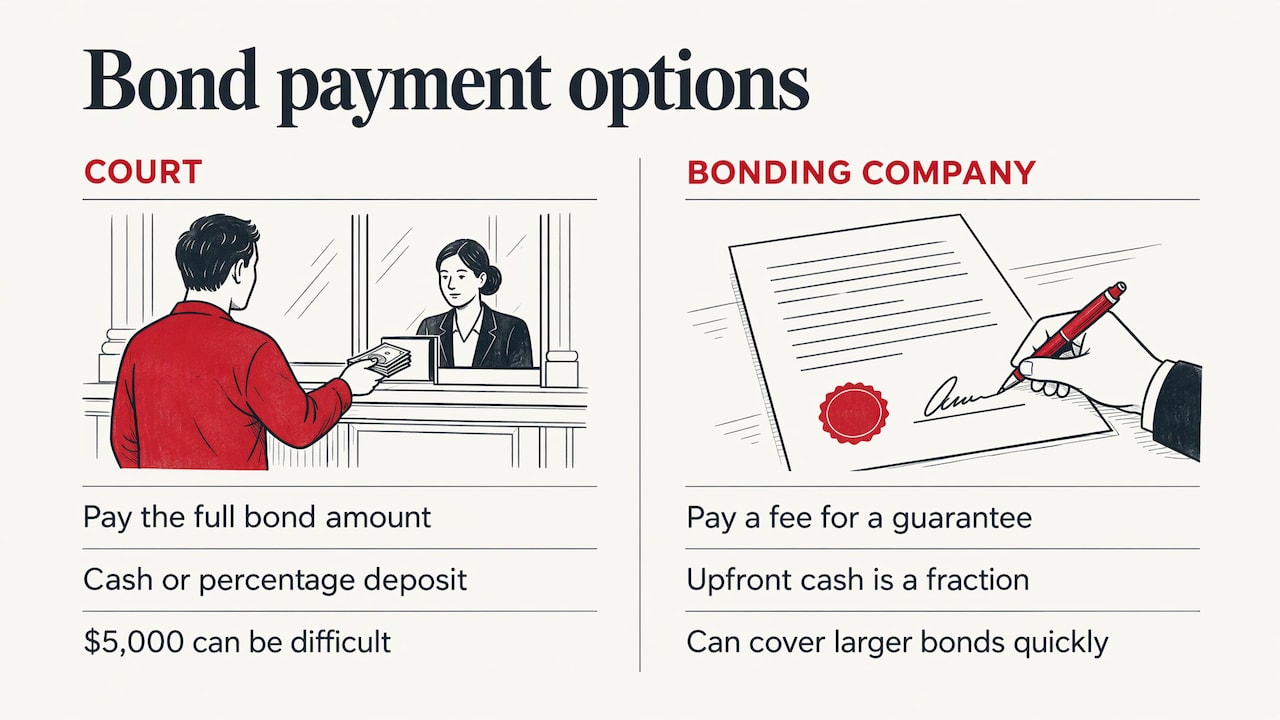
Paying the court directly. Some courts take cash or a percentage deposit at a clerk’s window or jail bond desk. Tarrant County’s bond desk, for instance, accepts bonds around the clock, but payers there must pay the full bond amount. That is fine for a $150 traffic bond and very hard for a $5,000 one.
Using a bonding company. You pay a fee, and the company guarantees the full amount to the court. For many families this is the only realistic way to cover a larger bond quickly, because the cash needed up front is a fraction of the total. In Las Vegas, that is the service we provide, including for failure-to-appear matters that begin with a traffic case. See our failure to appear bail bonds page.
Whichever path you choose, expect to show current photo ID. Franklin County’s municipal court accepts bond payments in person with cash or credit card and ID, and says the clerk sends documentation to the jail, after which the Sheriff’s Office should release the defendant within 6 to 12 hours unless other holds appear.
That last phrase matters. A traffic bond only frees someone who is held on that charge alone. If the person also has a warrant from another court, a probation hold or an immigration hold, posting the traffic bond will not open the door. Ask about every hold before you pay.
For the general process of posting for someone, our walkthrough on how to bail someone out covers the order of events from first call to release.
What a traffic bond costs
Costs are the main thing families ask about, and the honest answer is that it depends on the court’s bond schedule and the way the bond is posted. Three official examples show the range of structures.
A court-set bond with fees
Coshocton Municipal Court in Ohio lists a $1,000 bond for a first-degree traffic misdemeanor for an Ohio resident as $100 plus $39 in state fees and a $25 surcharge, $164 in total. A $500 bond for a second-degree traffic misdemeanor totals $114. These are the court’s own figures for its own schedule, so treat them as an illustration of how fees stack, not a price you will see everywhere.
A 10% deposit bond
Michigan law lets a person bailed on a traffic offense or misdemeanor deposit 10% of the bail, but at least $10, with the clerk. When the case ends, the clerk returns 90% and keeps 10% as bail bond costs. If the accused is not convicted, the entire deposit is returned.
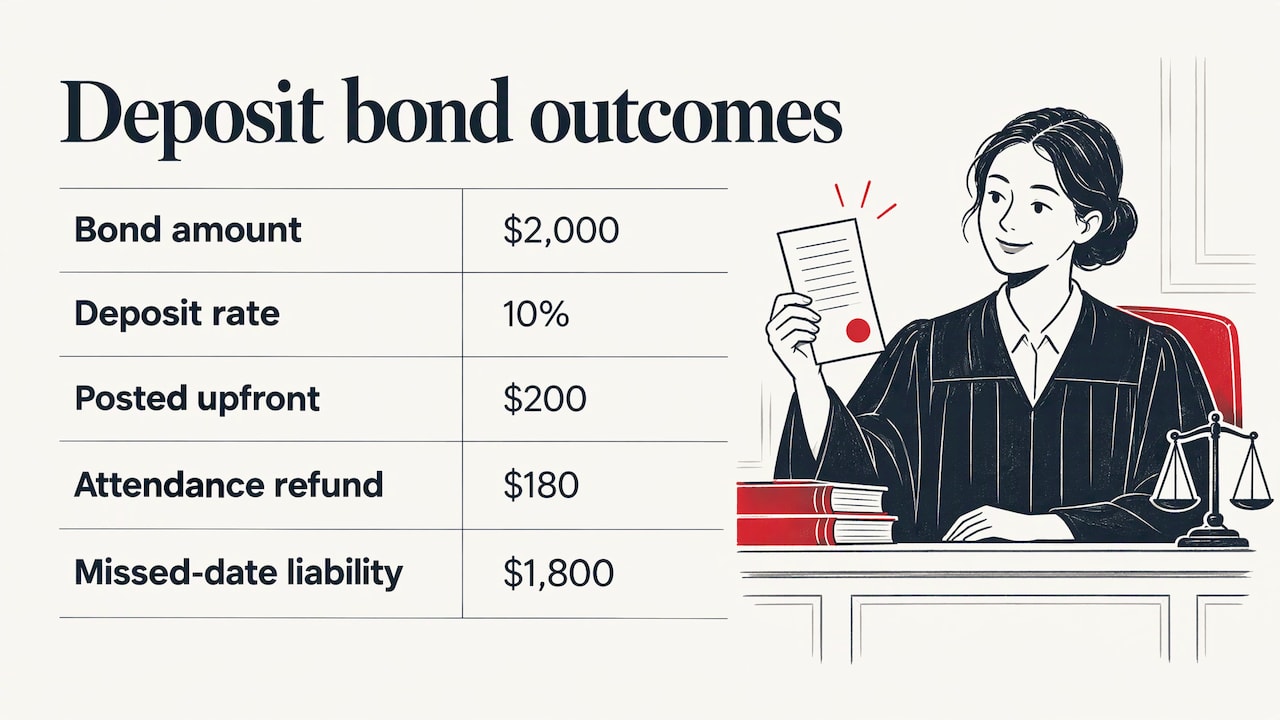
Perrysburg Municipal Court in Ohio gives a clear worked example. On a $2,000 appearance bond you post $200. If the defendant attends every appearance, 90%, or $180, is refunded. If the defendant misses a court date, the person who posted is liable for the remaining $1,800 and the court enters a judgment.
A surety bond through a bonding company
Here the fee is paid for the guarantee. Using the 10% benchmark from the Ohio court above, a $1,000 bond would mean a $100 fee and a $2,000 bond would mean $200. That is a general benchmark, not a quote. We do not publish a price list, and the actual amount depends on the bond set and the terms of the agreement. In Las Vegas, we explain the cost and any payment or collateral terms before anything is signed, so you know your obligations from the start.
Quick comparison
| Type | What you pay up front | What can come back | Main risk |
|---|---|---|---|
| Full cash bond to the court | The whole bond amount | Most or all after the case, minus fines and costs the court applies | Tying up a large sum |
| Percentage deposit to the court | A set share, such as 10% | Part of it, depending on the court and the outcome | Liability for the remainder if the defendant misses court |
| Surety bond through a bonding company | A fee based on the bond amount | Not a refund of the fee; the bond itself is released when the case ends | Liability for the full amount if the defendant misses court |
If a fine is owed, it can come out of the money you posted. Racine County, Wisconsin, notes that fines, fees and costs may be paid out of a cash bond without further notice, and that refunds arrive by mail within four to six weeks after the case is resolved. Budget for that wait.
What a co-signer takes on
If you are signing for a spouse, child or friend, you are not just helping with paperwork. You are the person the court or bonding company will look to if something goes wrong.
The Coshocton court states it directly: a surety must sign the bond form and is liable for the full bond amount if the defendant fails to appear. In practice, a co-signer commits to three things:
- Making sure the defendant knows every court date. Missing one is the most common way a small bond becomes a big problem.
- Staying in contact. If the person moves, changes numbers or stops answering, you are the one who has to find out why.
- Paying what the agreement requires. This includes the fee and any payment or collateral terms you agreed to.
Before you sign anything, ask for the court date, the charge, the bond amount, the fee and every condition in writing. With us, families get case-specific guidance on bail costs, bond paperwork and financial responsibilities rather than scripted answers. Our guide on conditions of release and missing court is a good read before you commit, and so is how bail works.
What happens if the defendant misses court
The consequences escalate quickly, and they fall on both the defendant and whoever posted.
- A warrant and possible new charges. Racine County explains that a missed court date triggers a warrant, a possible bail-jumping charge and bond forfeiture.
- Judgment for the full amount. Under Michigan law, if the accused does not comply, the court orders forfeiture and mails notice. If the accused does not surrender within 30 days, the court enters judgment for the full bail plus costs, and the balance can be collected like a civil judgment.
- Installment plans that fail. In California, a clerk may accept at least 10% of the total bail on an infraction if the defendant signs an agreement to pay the rest on a schedule. Missing an installment can lead to a failure-to-appear charge, a civil assessment or an arrest warrant.
If a court date has already been missed, act the same day. A person who comes back voluntarily is in a far better position than one who waits to be picked up. For Nevada, read what happens when someone bailed out does not go to court and whether a co-signer can cancel a bond after a missed court date.
Rules keep changing: a California example
Traffic rules are revised often, so a bond that worked one way a few years ago may work differently now. California’s 2024 summary of court-related legislation says AB 3278, effective January 1, 2025, removed the requirement for courts to notify the DMV of a failure to appear or pay a Vehicle Code fine, and updated the Penal Code so that failing to appear in traffic court is no longer a misdemeanor. The same summary notes that Rule 4.107 now requires reminder notices for infraction cases to state the total bail amount, payment options, ability-to-pay procedures and failure-to-appear consequences, including a civil assessment of up to $100.
The point for readers in any state: do not rely on what a friend went through five years ago. Ask the court clerk for the current rules on your case.
How we help with traffic bonds in Las Vegas
When the arrest is in Las Vegas or Clark County, the fastest route is usually a single conversation about the case. We arrange commercial bail bonds for traffic violations and related matters, help you find the person in custody, explain the bail cost and your payment obligations, and guide you through the bond application and posting. Our approach is personal and specific to your situation: you will understand what you are signing and what it asks of you.

Start with our traffic violation bail bonds page, or see everything we handle on our bail bond services page. If the traffic matter involves a misdemeanor charge, our misdemeanor bail bonds page covers that, and DUI cases are on our DUI bail bonds page.
FAQ
What is a traffic bond?
It is a guarantee that a person arrested on a traffic charge, or on a warrant for an unpaid ticket, will return for court. It can be posted as cash to the court or as a surety bond through a bonding company. Either way, someone is responsible for the full amount if the defendant does not appear.
How much does a $1,000 bond cost?
It depends on how it is posted. A bonding company fee is commonly about 10%, which would be $100 on a $1,000 bond, according to one Ohio municipal court. Court-run schedules differ: Coshocton Municipal Court lists $164 in total for a $1,000 first-degree traffic misdemeanor bond, including state fees and a surcharge.
Can you go to jail if you do not pay a bond?
The bond itself is not a debt that sends you to jail, but the consequences of default are serious. If the defendant misses court, the court can issue a warrant and order forfeiture, and the person who signed can be liable for the full amount. Under Michigan law, the court can enter judgment for the full bail plus costs if the accused does not surrender within 30 days.
How much do you pay on a $500 bond?
Again, it depends on the court and the method. Coshocton Municipal Court lists a $500 second-degree traffic misdemeanor bond at $114 in total. With a bonding company at a 10% benchmark, the fee would be $50. In Las Vegas, we explain the exact figure for your case before you sign.
How long does release take after a bond is posted?
It varies by jail. One Ohio county says the Sheriff’s Office should release the defendant within 6 to 12 hours after the clerk sends the paperwork, unless additional holds appear. Other holds are the most common reason for delay.
Sources
- Traffic FAQs, Connecticut Judicial Branch
- California Rules of Court, Title 4
- Incarcerated Person Location and Information, NYC311
- Find outstanding traffic tickets and arrest warrants, Washington State Courts
- Bond Information, Tarrant County Sheriff
- Criminal/Traffic FAQ, Franklin County Municipal Court Clerk
- Court Rules and Regulations, Coshocton Municipal Court
- Traffic Division, Perrysburg Municipal Court
- Act 257 of 1966, Bail for Traffic Offenses or Misdemeanors, Michigan Legislature
- California Vehicle Code, Section 40510.5
- Criminal & Traffic Court, Racine County Clerk of Circuit Court
- 2024 Summary of Court-Related Legislation, California Courts